
Let’s face it: B2B content marketing today feels like running a marathon at a sprinter’s pace. With increasingly discerning buyers, complex decision-making units, and dozens of digital touchpoints, B2B marketers are under pressure to produce more content – faster, smarter, and tailored to micro-audiences. That whitepaper can’t just live on your website anymore; it needs to be a blog series, a LinkedIn post, an email sequence, and maybe even a webinar deck. Multiply that across segments, personas, and regions, and the workload becomes overwhelming.
This content challenge isn’t just a matter of volume. It’s about velocity, relevance, and quality – at scale. And until recently, marketers had to rely on large teams, long hours, and linear workflows to meet these demands.
That’s where Generative AI (GenAI) comes in – not as a shiny new tool, but as a transformative force. GenAI doesn’t just make content creation faster; it reshapes how content is ideated, produced, and personalized. It accelerates ideation cycles, reduces production costs, and unlocks new creative potential.
But GenAI isn’t magic. It doesn’t eliminate the need for human creativity, strategic oversight, or ethical rigor. It simply redefines the roles.
In this new paradigm, the marketer’s job evolves from creator to curator, from writer to orchestrator. The most successful marketers will be those who partner with GenAI – strategically and responsibly. In this opinion piece, let us look at how marketers need to evolve in the new GenAI era to ensure they stay relevant and competent.
From Blank Page to First Draft in Minutes: The Speed Factor
Think about the last time you had to write a blog post from scratch. How long did it take to brainstorm ideas, research, outline, draft, revise, and finalize it? Hours? Days?
Now imagine feeding a clear, concise prompt into a GenAI platform and receiving a fully formed draft in under five minutes. That’s not the future; it’s today’s reality.
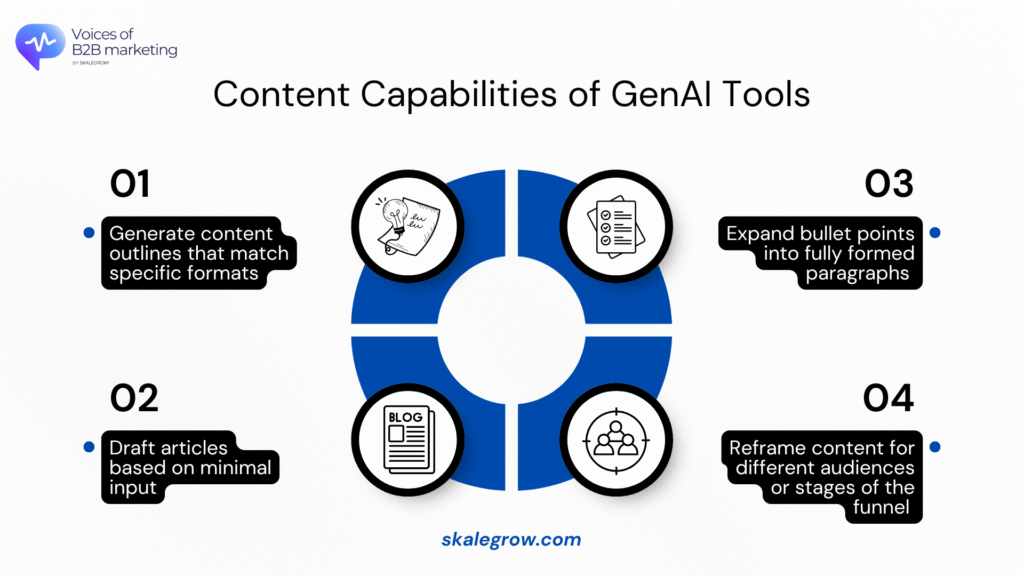
Modern GenAI tools can:
- Generate content outlines that match specific formats (e.g., case studies, whitepapers, emails).
- Draft articles based on minimal input.
- Expand bullet points into fully formed paragraphs.
- Reframe content for different audiences or stages of the funnel.
These capabilities are built using large language models trained on billions of data points, including B2B-specific content. That means GenAI understands your industry’s terminology, common pain points, and the psychological nuances of decision-making in complex sales.
For B2B marketers, this means the end of the blank page. Time once spent wrestling with introductions and transitions can now be spent refining message clarity, aligning with brand voice, and injecting fresh insight.
But remember: Speed isn’t the goal. Speed with strategic impact is. That’s where the human comes back in.
One Size Fits No One: Personalization in the AI Era
In B2C, personalization is a competitive advantage. In B2B, it’s needed for survival. Buyers today don’t just expect relevance – they demand it. They want to see that you understand their industry, their challenges, and their unique role within the organization.
But personalization at scale has always been difficult. Until now.
With GenAI, marketers can:
- Auto-generate multiple content variations for different buyer personas.
- Tailor messaging based on firmographics, behavioral data, and CRM inputs.
- Dynamically adapt email content, ad copy, and landing pages to reflect the user’s context in real time.
For example, a single prompt can create email sequences for CTOs in the healthcare sector and procurement officers in manufacturing, each with distinct value propositions and language. Add integrations with CRM or intent data platforms, and personalization can be not just targeted, but predictive.

Moreover, GenAI turns every asset into a content hub. A whitepaper becomes five blog posts, a LinkedIn post, a webinar script, and a newsletter. This kind of repurposing ensures message consistency while dramatically increasing content output.
Even more impressive, some GenAI platforms now support end-to-end nurture flows. You can prompt an AI agent to build an entire email sequence, aligned to specific funnel stages and customer segments, with appropriate CTAs and value messaging embedded throughout.
This isn’t personalization as a tactic. It’s personalization as infrastructure.
Not So Fast: The Caution Tape Around GenAI
Despite its power, GenAI is far from foolproof. And marketers who embrace it uncritically may find themselves facing unexpected challenges.
1. Hallucinations Happen
GenAI can generate false or misleading information with alarming confidence. From made-up statistics to incorrect product details, these “hallucinations” can slip through if human review is skipped. In regulated industries, the consequences could be severe.
2. Bias in, Bias Out
If your AI is trained on biased data – and most models are to some degree – it will replicate those biases in your content. This might result in exclusionary language, lack of representation, or insensitive messaging. B2B brands must actively audit and edit for fairness, inclusivity, and accuracy.
3. Creativity Has Limits
AI is excellent at recombining existing ideas but terrible at creating new ones. It lacks the lived experience, intuition, and imagination that fuel true innovation. Left unchecked, GenAI can make your content sound polished but painfully generic.
4. The Human Cost
Entry-level marketers, copywriters, and interns are most at risk of displacement as automation increases. However, new roles are emerging: AI content strategist, prompt engineer, and model trainer. The future belongs to those who can collaborate with AI rather than compete with it.
How Smart Marketers Are Building an AI-First Workflow
The best marketing teams aren’t rushing to automate everything. They’re building thoughtful, AI-first systems that blend speed with strategy.
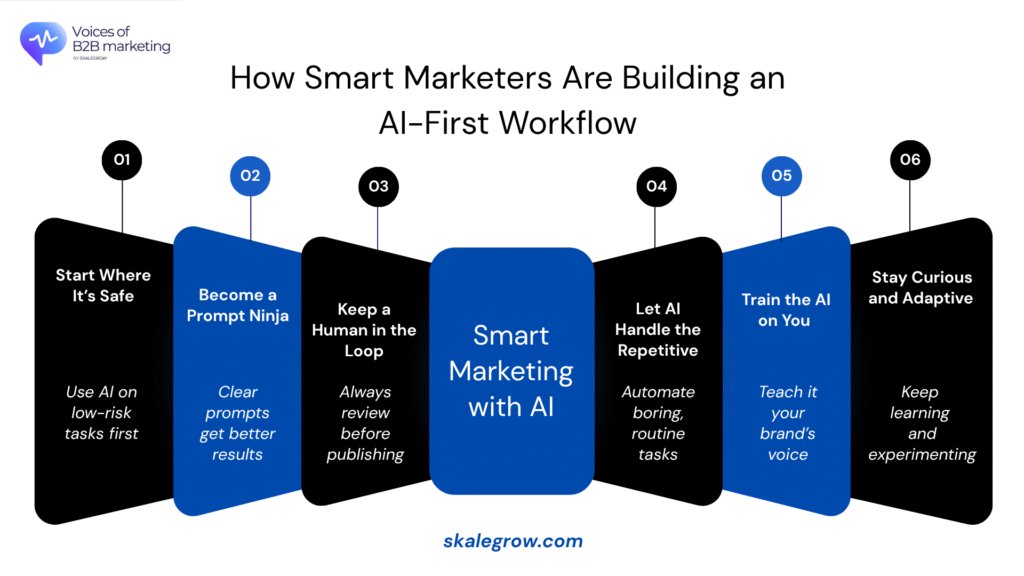
1. Start Where It’s Safe
Begin with internal or low-risk content. Use GenAI to draft memos, create outlines, or repurpose blogs. This helps teams build confidence and refine processes before using AI for external communications.
2. Become a Prompt Ninja
Prompt engineering is the new copywriting. Clear, specific prompts yield better results. Marketers should learn how to structure inputs that specify audience, format, tone, and desired output. Over time, prompt libraries can serve as creative assets.
3. Keep a Human in the Loop
No GenAI content should go live without human review. Editors should look for factual accuracy, brand alignment, tone consistency, and ethical integrity. AI is the co-writer, not the publisher.
4. Let AI Handle the Repetitive
Outsource routine tasks like:
- SEO meta descriptions
- Social media captions
- Drafting FAQs
- Transcribing webinars
Use the time saved to focus on creative strategy, customer research, and cross-functional collaboration.
5. Train the AI on You
Fine-tune GenAI tools using your own brand’s content, messaging guidelines, and high-performing assets. This increases consistency, improves quality, and reduces editing time. Some platforms even allow for brand-specific LLM training.
6. Stay Curious and Adaptive
New features emerge weekly: image generation, multimodal input, autonomous agents, and voice cloning. Staying current ensures you can leverage the best tools while avoiding hype traps. Continuous learning is part of the new marketing mindset.
The Future Isn’t AI vs. Human – it’s AI with Human
Let’s kill the narrative that GenAI is here to replace marketers. It’s not.
What GenAI is doing is transforming how we work, what we prioritize, and where we create value. It’s eliminating the drudgery so we can focus on the strategic. It’s helping us scale relevance without sacrificing quality. It’s making room for creativity by automating the mundane.
But like any tool, its effectiveness depends on how we wield it. The best B2B marketers won’t just use GenAI – they’ll design for it. They’ll build systems where humans and AI collaborate seamlessly to meet business goals. Because at the end of the day, marketing is still about connection. It’s about trust, empathy, and resonance. And those are things only humans can truly deliver.
So embrace GenAI. Experiment with it. Master it. But never forget: It’s your voice, your insight, and your creativity that give the machine its meaning.
The future isn’t man vs. machine. It’s man + machine vs. irrelevance.
And that’s a battle worth winning.
About the Contributor
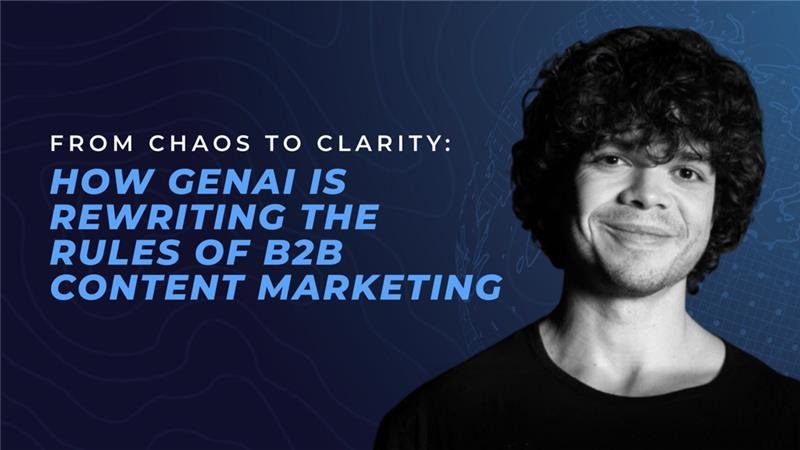
Santiago Cuba de Reed
Growth Marketing Lead
DiUS, Australia

Santiago Cuba de Reed is a seasoned marketing professional with over a decade of experience spanning national (ANZ), regional (APJ), and global roles – most notably at SUSE. His career path includes pivotal positions at creative agency Synapsis Creative and digital agency Neon Logic. He has also worked in Multi-Channel Network, where he partnered with major broadcasters like Ten and Foxtel. This diverse background has equipped him with deep expertise across both traditional and digital marketing platforms, including television, print, social media, and SEM.
Currently working at DiUS, Santiago is helping shape the future of AI and emerging technologies across the Asia-Pacific region. Known for seamlessly blending marketing and sales strategy, he maintains a sharp focus on ROI while fostering strong, collaborative relationships. He thrives on connection – ensuring alignment between client needs and agency capabilities, and building partnerships grounded in trust and transparency.
Outside of work, Santiago channels his creativity through fashion design, painting, and a love for literary classics. He’s also a dedicated film and television enthusiast with a special appreciation for deep storytelling and cinematic craft. In his community, he proudly serves as a Board Member of Top Gym, supporting accessible and inclusive fitness for all.
Connect with him here to chat marketing, creativity, or classic cinema.