
AI of today is seen as an engine for growth and transformation – seemingly a silver bullet to redefine business in a gamut of areas including financial performance, cost reduction, customer satisfaction, operational efficiency, employee engagement and development.
Yet the question remains, where can AI really move the needle where businesses can see revenue growth, customer retention and increased productivity?
While AI has much hype, the real deal comes only when it can be an enabler and optimizer so that businesses can do more with less time and effort.
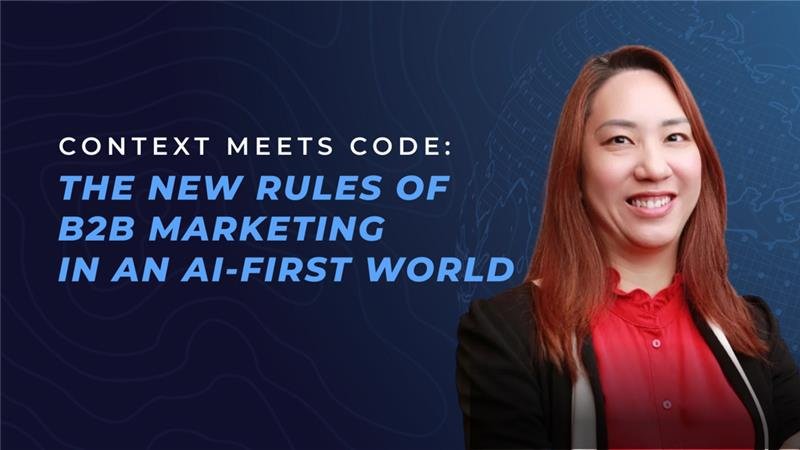
There are two trends emerging, one in the area of contextual AI and secondly in changing buyer dynamics due to generative AI and agentic AI. In this article, let us explore how focusing on context and the changing buyer behavior can help B2B marketers apply AI better across various applications.
Making AI Work Where It Matters Most
In the B2B marketing world, there is an increased demand for contextual AI, which merges insights from three key areas: customer data, the context – which includes the industry nuances – and meaningful connections through MarTech.
I view industry-driven data in AI marketing as a best practice approach to the use of AI as it integrates public data with your unique first-party data. When you are training your large language models, you need good data. While public large language models (LLMs) use massive amounts of data, they don’t get you the specific insights into your business that you need.
Meanwhile, your business has a wealth of data specific to your unique environment. By bringing your unique data to your AI models via API integration and combining it with public data, you can uncover valuable insights, create tailored offerings, and refine processes that provide a competitive edge.
Connected Data as a Strategic Asset
For brands to take full advantage of AI, there needs to be a proper data strategy. The human element of crafting that right data strategy is foundational and cannot be so easily replaced by the machine. Humans help set parameters, guide training of AI models, eliminate biases, and provide governance. This allows for the ability to harness data well so that quality data feeds into your AI models, critical to improve productivity. With the right data strategy in place to handle AI complexity, brands can then focus on productivity and profitability. True power is released when you’re able to use data combined with the right AI applications and tools to transform your business end-to-end.

AI needs to be built on the right data and platform strategy in order for brands to extract real value. B2B marketing is becoming highly intent-driven and data-driven, and brands should use these intent data to effectively identify and act on customer pain points, buying behaviours, and intent signals.
Marketers of tomorrow need to know how to interpret data and make data-driven decisions by being savvy with the relevant AI applications and tools they can use in their specific industry context.
Changing buyer dynamics due to the rise of AI
The second trend is in the changing dynamics of B2B buyers. Besides the increased use of Generative AI tools to support buyer research, the types of buyers who influence a purchase decision are also evolving. These influencers are not just human, they include machines and AI agents who have been trained to make purchase decisions.
Increased use of Generative AI tools to support buyer research
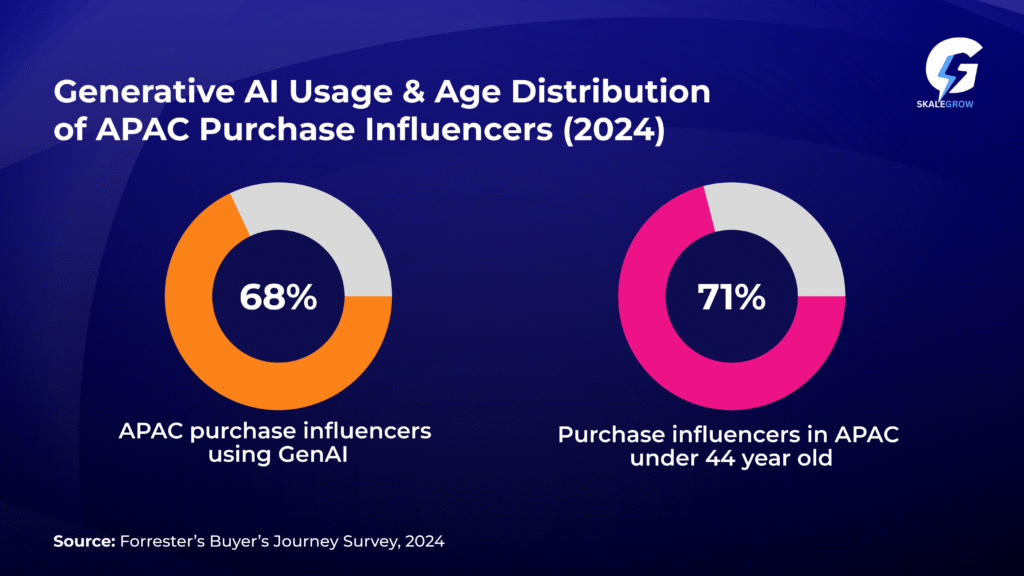
The Forrester’s Buyers’ Journey Survey, 2024, shows that 68% of Asia Pacific (APAC) purchase influencers are also using GenAI to gather information about vendors.
Specifically in the APAC region, purchasing power has shifted to a younger generation of buyers. In fact, 71% of purchase influencers in APAC are under 44 years old. They primarily seek information about vendors through interactions with a mix of human and AI-driven influencers – including subject matter experts such as analysts, partners, consultants, and industry influencers, as well as insights generated by Gen AI tools.
Owing to these, Marketing is now required to have intelligent, purposeful digital engagements for both human and AI.
With this reliance on large and diverse buying committees for B2B buyers, marketing and the wider product, analyst relations, consulting, and sales teams need to work cohesively to facilitate connections between the influencers, partners, and customer advocates.
Companies should also reevaluate their digital and content strategies to optimize for AI search. It’s essential to consider how AI tools identify user intent. Marketing has a significant opportunity to shape a brand’s narrative in the AI landscape by creating high-quality, clear, structured, and differentiated content.
Additionally, companies need to remain vigilant even in the early stages of the buyer cycle by monitoring buying intent signals. This proactive approach is crucial for capturing mindshare and building trust during the discovery, evaluation, and consideration stages of the buyer journey.
A powerful approach involves developing insight-driven campaigns that seamlessly integrate a digital sales layer with traditional sales strategies. Utilizing AI as an enabler, analyzing buying intent signals, and making precise adjustments to ensure consistency between online and offline experiences are non-negotiable strategies for marketing.
From Humans to AI Agents: Rewiring B2B Lead Funnels
With the rise of AI agents, we are observing a change in the buying network for B2B purchases. Apart from internal buyers that are part of the organization making the purchase, there is a shift to agentic AI buyers trained in the industry context and armed with specific criteria to support buyer research and vendor recommendations.
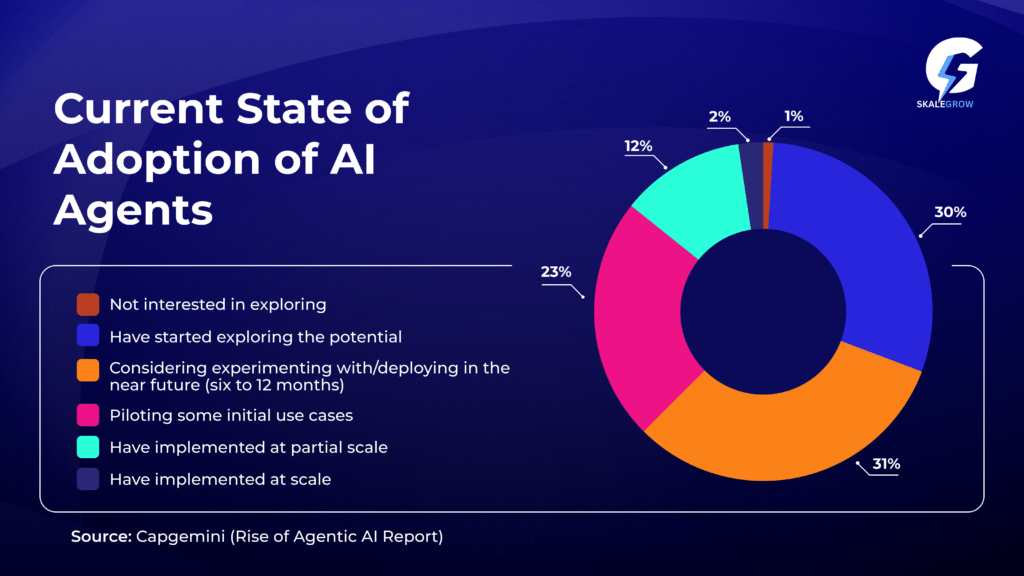
According to Capgemini, 14% of organizations have already implemented AI agents, 12% at partial scale, 2% at full scale and nearly one-quarter (23%) have launched pilots, while another 31% are preparing for or exploring deployment in the next 6-12 months.
Increasingly, there is so much experimentation (61%) with AI agents to drive productivity and it’s vital to equip them with industry-specific context and rich vertical and horizontal feature sets to release agentic AI’s potential.
AI-powered agentic commerce
AI Agents are built using generative AI models to make decisions and take action either semi or fully autonomously. Imagine a future where an AI agent can buy securely and seamlessly either supervised or in a fully automated manner, trained by your unique first party data with the context and reasoning to create action plans and next steps. This trend will transform the way B2B customers handle procurement, from selecting suppliers, onboarding them and managing purchases, even post-purchase management.
How to Market for Machines, Not Just Humans
While the use of agentic AI is moving from the pilot stage to actual live use cases, how can marketers win in the age of Agentic AI?
Here are 4 ways:
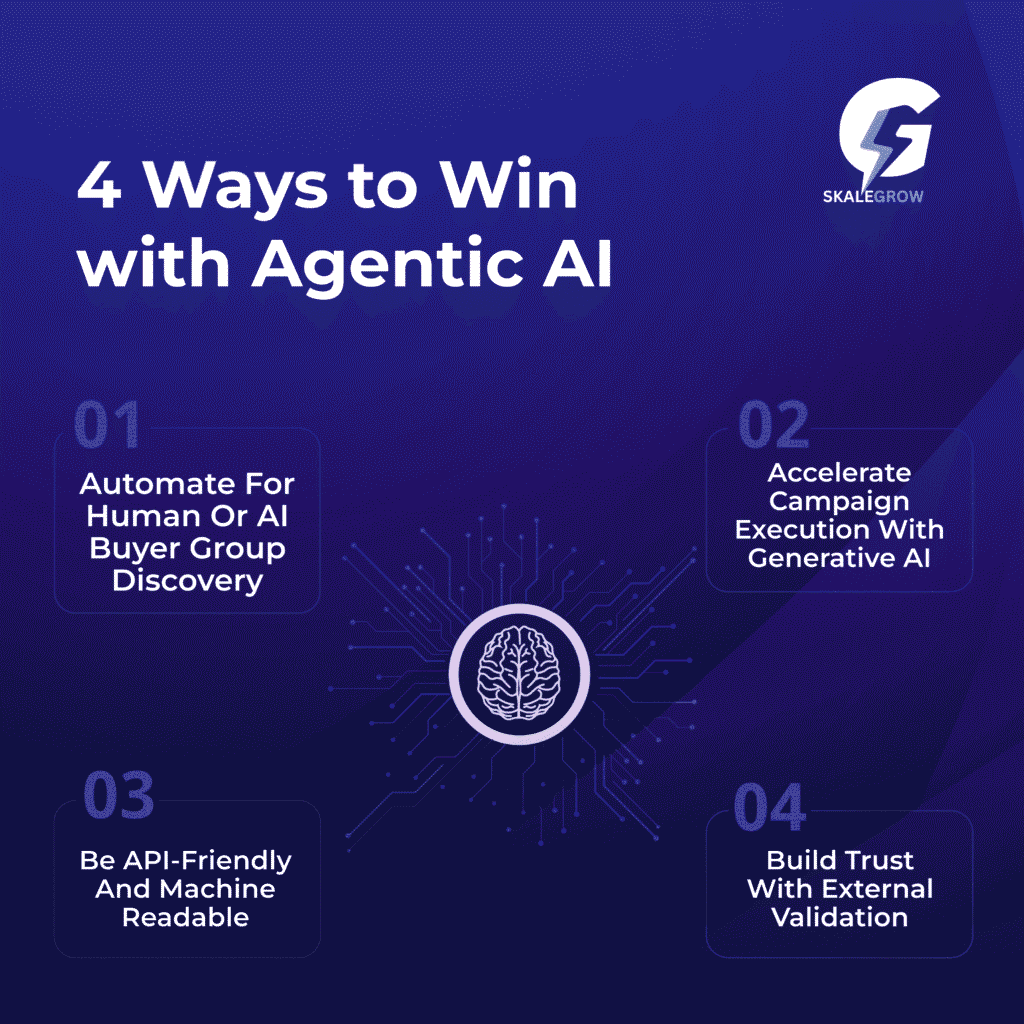
1. Automate for Human or AI buyer group discovery
Marketers need to assess the new mix of buyer profiles. Are they a mix of internal buyers and external influencers, human or AI buyers? Are decisions collaborative between both human and AI or can the machine make decisions autonomously?
With the use of AI intent-based buyer signals, competitive intel and CRM data tracking new customer wins and win/loss takeaways, marketers can have a better understanding on buyer groups and designing campaign pathways specific to them – whether they are human or AI buyers.
2. Accelerate campaign execution with Generative AI
AI, if used well, can help you amplify a strong campaign and retention strategy. With a mix of both human and AI buyers, Generative AI can help marketers to accelerate the campaign journey creation process from audience segmenting, decision logic (creation of split paths etc), customizing content and coordination across multiple platforms.
Marketers who can integrate their own in-house first party client data, providing their AI with context from their CRM, will have more accurate account-based targeting and better recommendations on next-best action in terms of content and channel engagements.
According to Gartner’s AI in Marketing study, brands saw a 34% faster path to optimization via A/B testing of AI-generated variants. One can expand a single content piece both globally and locally and optimize for a variety of digital channels in various market contexts and languages.
3. Be API-friendly and machine readable
With nearly 70% B2B buyers through their purchasing process before engaging with vendors, purchase journeys have to be well-designed. Marketers need to ask themselves if their campaign contents and value proposition can be understood by an agent without human intervention.
Ensure your digital content is rendered for both front-end users and the back-end with structured metadata. Build trust by making your descriptors and benefit statements for human buyers and agents to process and make meaningful comparison.
For your brand’s website, this can be done on the backend with robot-readable structured content elements like FAQ schema, products and solutions schema. Both these tactics help contribute to stronger search results in both traditional SEO and Gen AI assisted searches.
4. Build trust with external validation
With the increased reliance on external validation from market analysts and review sites in purchase decisions, one needs to ensure that your product review and ratings can be easily digestible and are from verified sources. By integrating 3rd party reviews via APIs into your digital and web content, you can ensure easy access by both humans and agentic buyers.
Also, build human and agentic trust by broadcasting that your product is compliant or certified under recognized international standards such as ISO, GDPR, ESG etc. – a key criterion that buyers can checkbox.
These 4 tactics can help propel potential human or AI agentic buyers forward in the buying cycle, significantly accelerating the sales process by clearly demonstrating value. This proactive marketing approach secures a pivotal role in management decisions, influencing the go-to-market strategy and showcasing its undeniable impact on overall business revenue outcomes.
Final Thoughts
The future of B2B marketing will belong to those that use AI effectively, along with the best of what humans can offer including complex problem-solving, emotional intelligence and prioritising ethics and trust.
AI is here to collaboratively help us work faster, make better choices, and get better results but it requires the humans to be trained and finetuned.
Think of AI as an extension of your marketing team, giving you more time to focus on higher value tasks and more on what really matters, such as building strong relationships, adding value and connecting with your buyers.
With the changing buyer dynamics, AI tools are now influencing choices more than ever, so marketers need to anticipate the needs for both human and AI buyers. Start now and use AI with purpose to stay ahead.
About the Author
Sharon Tan
Field Marketing Lead
Oracle Financial Services

Sharon Tan is the Field Marketing Lead, JAPAC, Oracle Financial Services. She oversees the region’s GTM marketing strategy, analysing market potential, competitors, partners, persona and segment needs to define and execute marketing programs based on business priorities.
She also serves on the board of the FinTech Marketing Community as a regional chapter co-chair.
B2B marketing has been Sharon’s passion for the last 17 years, and she has developed domain expertise in industry marketing by working at cloud hyperscalers, SaaS, and technology companies. In the last 11 years at Oracle and NICE Actimize, she has sharpened her domain expertise in financial services marketing, covering topics like AI, cybersecurity, payments, financial crime and compliance, data monetization, and analytics.
Across Sharon’s career, she has also taken on global digital and regional field marketing roles in Asia Pacific and Middle East Africa, mentoring and leading multi-cultural teams spanning Singapore, India and the U.S.
Sharon’s strategic approach to marketing campaigns has been recognized regionally with several awards, including the Market Development of the Year Award from Oracle and the Gold Winner for Integrated Marketing Campaign (B2B) from Marketing Magazine.
About Skalegrow
Skalegrow is a B2B marketing agency that helps companies in the IT, tech, SaaS, robotics, and embedded systems industries grow with marketing. Our services include content marketing, SEO, email marketing, video marketing, graphic design, website management, performance marketing, staff augmentation, and LinkedIn marketing. Our vision is to transform marketing into a business-critical function in B2B companies by making marketing the main growth lever for our clients. To learn more about our capabilities, please visit the services page.